
Ointment Cream Mfg Plant
OINTMENT / CREAM MFG. PLANT
From Powders to Paste: Inside an Ointment/Cream Manufacturing Plant Ointment and cream manufacturing plants transform a variety
of raw materials into therapeutic topical products used for various purposes.
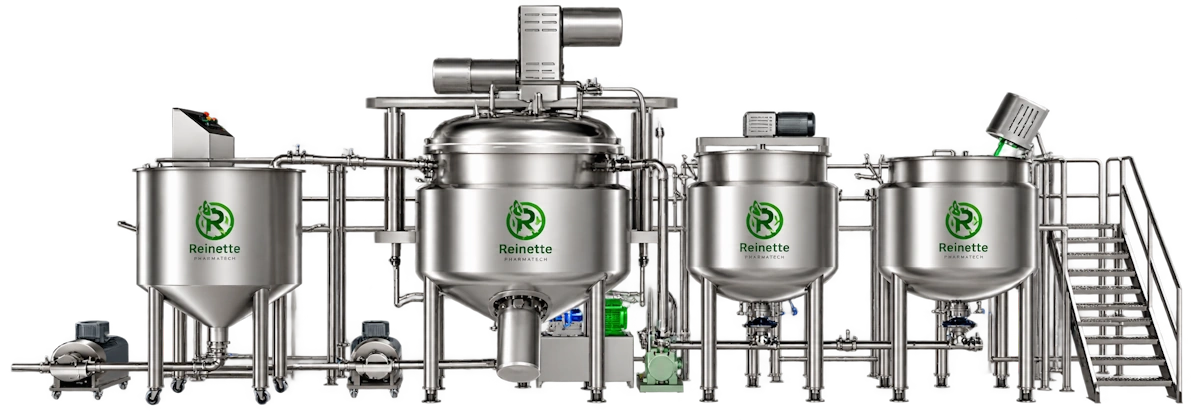
Salient Features:
Efficiency and Optimization:
Closed-loop systems: Minimize product loss and exposure, ensuring containment and safety, especially for potent APIs.
Integrated process control: Automates recipe management, parameter adjustment, and data logging for consistent quality and production optimization.
Continuous monitoring: Real-time data acquisition allows for timely interventions and improved process control, minimizing waste and production downtime.
Advanced Technologies:
High-shear mixers: Achieve superior uniformity and fine dispersion of ingredients, even for challenging formulations.
Colloid mills: Ensure ultra-fine particle size and smooth texture for a luxurious feel.
Aseptic processing: Enables sterile production of certain creams or ointments for sensitive applications.
Safety and Quality:
Stainless steel construction: Minimizes risk of contamination and provides easy cleaning.
HEPA filtration: Ensures clean air environment for product and personnel safety.
CIP (Cleaning In Place) systems: Automate cleaning procedures for efficient, thorough, and validated sanitation.
Flexibility and Sustainability:
Modular line design: Allows for customization based on product range, batch size, and future expansion needs.
Multi-purpose equipment: Single machines can handle different formulations, reducing production line footprints and capital expenditure.
Energy-efficient systems: Utilize low-energy equipment and processes to minimize environmental impact.
Integration and Data Management:
MES (Manufacturing Execution System) integration: Enables comprehensive data tracking, reporting, and traceability for regulatory compliance and process improvement.
Paperless documentation: Improves process transparency and streamlines quality control processes.
Remote access and monitoring: Enables centralized control and troubleshooting for geographically dispersed facilities.
Additionally:
Validation protocols: Ensure equipment, processes, and cleaning procedures meet stringent quality standards.
Environmental monitoring: Control temperature, humidity, and pressure to maintain product stability and prevent degradation.
Track and trace systems: Implement robust systems for product authentication and counterfeit prevention, especially for valuable formulations.